Written By: Undefeated Healthcare Editorial Team
Reviewed By: Chase Butala MS LPC, LCPC
You are hyper-efficient. You stream a masterclass at 1.5x speed while running on the treadmill, text your partner about dinner while sitting in a budget meeting, and feel a literal jolt of physical irritation if the self-checkout line takes forty seconds too long. You tell yourself you are just driven, that you are the ultimate "Alpha" or an Enneagram

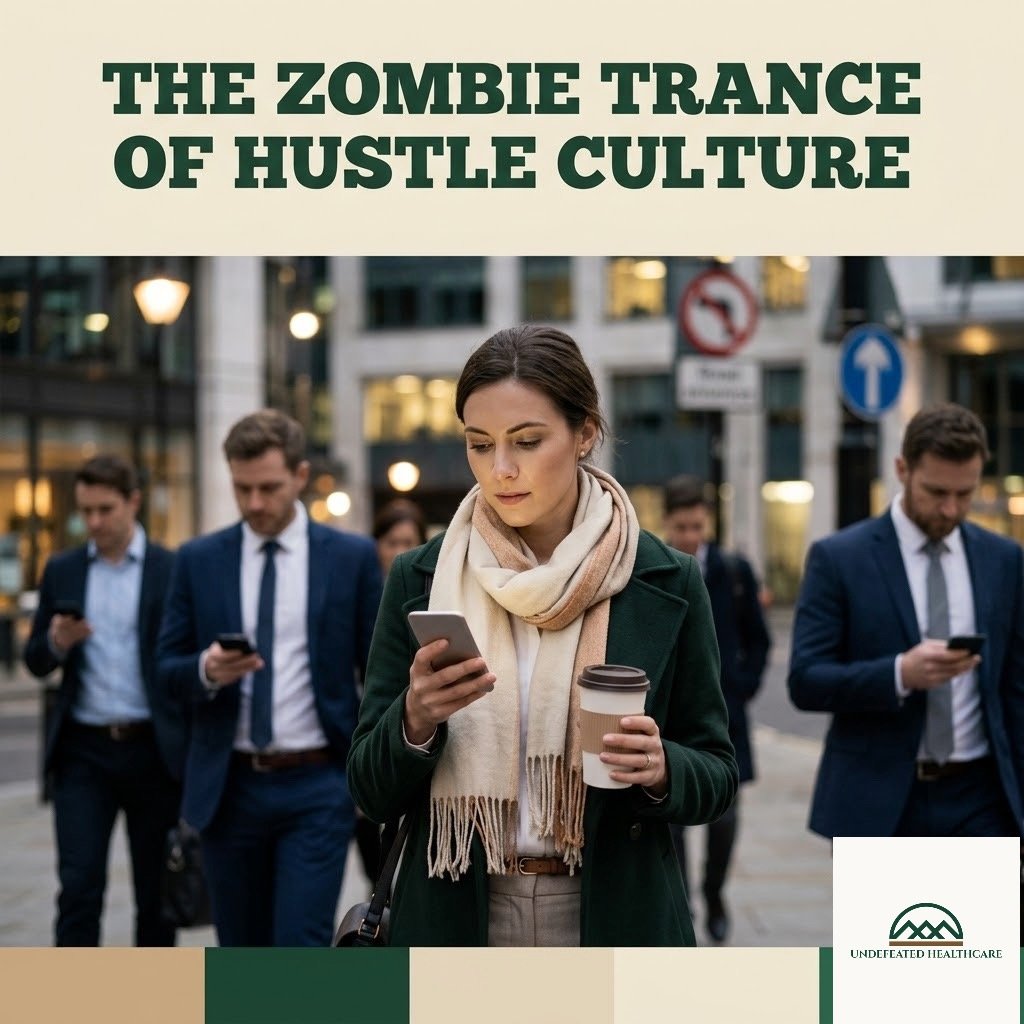
But let’s get radically honest. You aren't crushing it. You are chronically frantic. You are caught in a collective, zombie-like trance of perpetual hypervigilance, and it is destroying the very things you are supposedly hustling to protect.
At Undefeated Healthcare, we look at this through a systemic lens. In the groundbreaking article "The Hurry Sickness of Hustle Culture" published in Psychology Today, the depth of this modern malaise is laid completely bare. It highlights a culture obsessed with optimization, where time feels like a scarce resource that must be ruthlessly conquered.
We call this what it clinically is: Hurry Sickness. And here is the brutal truth that most self-help gurus won't tell you: your relentless optimization isn't an achievement. It is a defense mechanism.
To understand what this does to your brain, let's break down the evidence-based core of the Psychology Today piece into plain language. Your mind was designed to be a deep-sea diver—capable of plunging into deep thoughts, holding long-term memories, and building rich, meaningful layers of connection. Hustle culture turns you into a jet skier. You are skimming frantically across the surface of your life at eighty miles an hour, splashing a lot of water but never seeing what is underneath.
When you live on autopilot, your brain adapts. Through a process called neuroplasticity, your brain aggressively prunes—meaning it cuts away—the neural pathways that are underactive. As the research notes, if you don't use your capacity for deep focus, patience, and emotional presence, your brain literally throws those switches into the garbage. Your working memory shrinks, and your long-term memory becomes fragmented.
"Hurry sickness is a behavior pattern characterized by continual rushing and anxiousness. It is a malaise in which a person feels chronically short of time, and so tends to perform every task faster."
— Dr. Rosemary Sword and Dr. Philip Zimbardo, authors and psychological researchers.
Continue reading the full field note
We aren't just talking about a personal bad habit. This is a public health crisis. The American Psychological Association (APA) released its Stress in America report, explicitly subtitled A Crisis of Connection. The data shows a terrifying pattern: more than 50% of U.S. adults experience severe emotional disconnection and loneliness every single day. Furthermore, the American Psychiatric Association’s national poll revealed that 48% of adults report their chronic daily anxiety is actively worsening compared to previous years.
This is not a personality trait. It is a functional deficit.
Hurry Sickness does not stay contained in your laptop. It bleeds directly into your system—your home, your marriage, and your workplace.
The Frantic Lifestyle: It begins with over-scheduling, digital saturation, and treating daily life as a race to finish.
The Autopilot Brain: Continuous urgency forces the nervous system into fight-or-flight, turning off deep processing and executive functioning.
Relational Blindness: Because your brain is skimming the surface, you lose the ability to read subtle emotional cues from those around you.
Systemic Loneliness: The final result is a home where everyone feels unseen, isolated, and profoundly disconnected under the same roof.
In Relationships: Where attention goes, energy flows. Distraction starves a partnership. If you are an anxiously attached partner, hurry sickness amplifies your hypervigilance, causing you to constantly monitor your partner for signs of abandonment while never actually being present to connect. If you lean avoidant, the hustle becomes your ultimate armor—a socially praised excuse to avoid true emotional intimacy.
By Gender: We must aggressively smash the old, outdated cultural scripts keeping us stuck. For decades, society excused the hurried, emotionally unavailable man as a "classic providership archetype" and labeled the frantic, over-functioning woman as just a "busy, hyper-vigilant mother." This is toxic garbage. It traps men in lonely, isolated silos and burns women out to the point of somatic collapse.
Across Lifespans: It impacts every generation differently. We see ambitious 20-somethings destroying their nervous systems trying to match social media timelines, while older couples realize they have spent thirty years rushing past each other, leaving them looking at a stranger across the kitchen island.
As the great comedian Lily Tomlin once perfectly observed:
"The trouble with the rat race is that even if you win, you’re still a rat."
Choosing to slow down is not a sign of weakness; it is the ultimate act of defiance. The Undefeated Mindset treats personal development not as a corporate checkbox, but as a rigorous, daily somatic practice. Healing does not happen in a vacuum. It happens when you step out of the frantic matrix and step back into alignment with yourself and the people you love.
If you are trapped in this loop, you cannot think your way out of it. You have to experience your way out of it through relational work.
If you are ready to stop skimming the surface, here are the three core reasons you need to address this in a systemic therapeutic environment:
Are you using speed to outrun your history?
Many high-achievers use the frantic pace of life to avoid sitting with unresolved trauma, grief, or feelings of inadequacy. In therapy, we help you slow down enough to look at what you are running from.
How is your urgency fracturing your system?
You might think your rushing only affects you, but your partner and children are experiencing your distraction as emotional rejection. We map your systemic interactions so you can see the real-world ripple effect of your pace.
If your nervous system is hardwired for chaos, "relaxing" will actually trigger intense anxiety. We use evidence-based somatic tools to safely retrain your body to tolerate peace, stillness, and deep eye contact.
You do not have to do this alone. Beyond clinical therapy, structured community frameworks exist to help individuals dismantle the culture of urgency. Programs like Workaholics Anonymous (WA) provide highly effective, structured 12-step recovery processes aimed at stopping the compulsive cycle of rushing, over-scheduling, and chronic unsustainability.
The cost of refusing to fix this is astronomically higher than any insurance copay or monthly deductible you already pay. You are paying for your hurry sickness with your marriage, your long-term memory, your health, and your peace of mind. Stop trading your life for a checklist.
At Undefeated Healthcare, we specialize in systemic, relational healing for individuals, couples, and families. We don't just give you platitudes; we give you real, evidence-based tools to rewire your life and reclaim your connection to those who matter most.
Our world-class clinicians have immediate availability, including highly flexible appointment slots on evenings and weekends to fit into your world. We proudly accept all major insurance programs, making it easier than ever to utilize the benefits you already pay for.
Office Locations: Serving individuals, couples, and families across our regions with premier clinics located in Morgantown, West Virginia and Pittsburgh, Pennsylvania.
The most common presentations include chronic multi-tasking during conversations, treating household logistics like corporate mergers rather than shared life experiences, persistent irritability over minor scheduling delays, and an inability to engage in unstructured, playful intimacy without checking a device.
Yes. We accept all major insurance programs to ensure your care is accessible and sustainable. We routinely work with providers including Blue Cross Blue Shield, Aetna, Cigna, United, and Tricare.
We understand that when you are ready for change, you need support immediately. Undefeated Healthcare prioritizes rapid access to elite clinical care. We have clinicians with immediate openings, offering convenient evening and weekend sessions to ensure your path to healing fits seamlessly into your life.
Systemic therapy for chronic burnout and relational disconnection
Somatic practices for nervous system regulation in high-achievers
Evidence-based couples counseling for time-scarcity stress
This article is educational and doesn’t replace evaluation, diagnosis, or care from a qualified professional.