Written By: Undefeated Healthcare Editorial Team
Reviewed By: Chase Butala MS LPC, LCPC
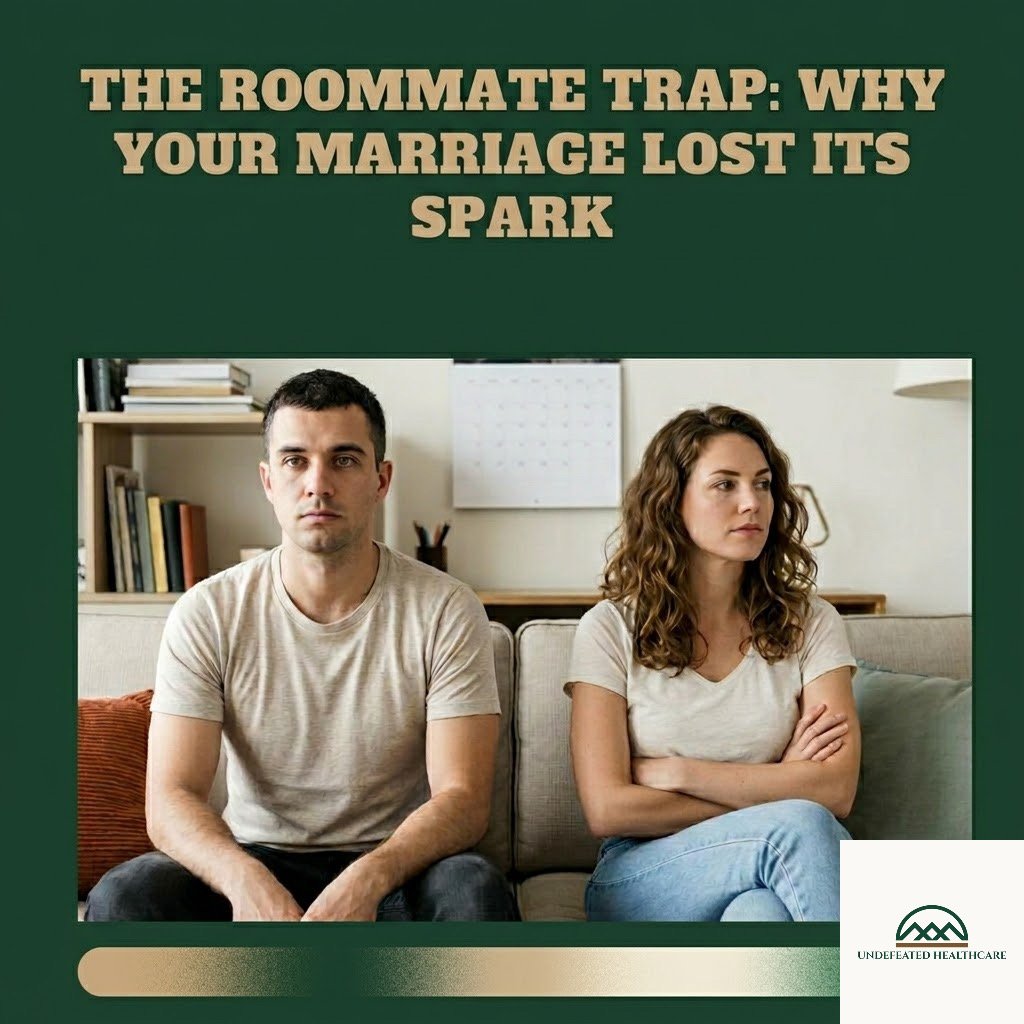
You know that specific, heavy silence in the car on the drive home from a grocery run? The one where nobody is technically fighting, but the air is so thick with unsaid words you could slice it with a coupon? You look over at your partner—the person who used to make your heart do actual gymnastics—and all you feel is a profound, exhausting sense of “roommate energy.” You love them. Of course you do. But the fire? It didn't just burn out; it feels like someone swept up the ashes, vacuumed the rug, and replaced the whole setup with a neatly folded pile of laundry and a shared Google Calendar.

If you are nodding along right now, I see you. I have sat across from hundreds of couples in my 15 years as a clinician, and I am here to tell you that this silent drift is the most common, painful, and deeply misunderstood systemic trap in modern relationships.
When passion dips, our immediate, panicked reaction is usually to assume that the love is gone or that we are fundamentally incompatible. We point fingers, or worse, we freeze. But if we look at this through a systemic lens—the foundational belief here at Undefeated Healthcare that individuals don't exist in a vacuum and that our healing happens in connection—we see a completely different culprit.
The issue isn't a lack of love. It’s that the day-to-day mechanics of running a life have completely crowded out the space required for desire to breathe. You aren't operating as lovers; you’ve accidentally optimized your relationship into a highly efficient, two-person logistics corporation.

According to data compiled by the American Psychological Association (APA), approximately 41% of first marriages face severe disruption, with a lack of emotional and physical intimacy consistently cited as a top-three driver of marital dissolution. This isn't an isolated "you" problem. It is a widespread systemic pattern that cuts across every single demographic.
How it presents in different settings: In early marriage, it looks like hyper-focusing on career building or adjusting to the shock of cohabitation. In the chaotic middle years, it’s the relentless demands of parenting.
The Age Factor: Interestingly, recent longitudinal research highlighted by the National Center for Family & Marriage Research shows a massive 36% of all modern divorces now involve adults aged 50 and older—a phenomenon known as "gray divorce." When the kids leave the nest and the logistical distractions vanish, couples are often forced to look across the kitchen island and realize they haven't spoken a word of genuine emotional substance in a decade.
"The opposite of love is not hate, it's indifference. And the absolute killer of passion is not conflict, it's the slow, quiet erosion of curiosity."
Continue reading the full field note
Let’s blow up some old-school, toxic nonsense right now, because the outdated cultural scripts we’ve been fed are actively keeping couples trapped in resentment.
For decades, popular media told us that men are simple creatures driven solely by physical urges, while women are the emotional gatekeepers who need a perfectly clean kitchen and a sonnet before they can even think about intimacy. This rigid, gender-essentialist garbage does a massive disservice to everyone.
Clinical relationship research completely refutes this. In fact, groundbreaking work from Dr. John Gottman at The Gottman Institute emphasizes that a thriving physical relationship is entirely dependent on the underlying framework of emotional intimacy and closeness. Men experience a deep, profound need for emotional safety and validation to fuel their passion, while women frequently struggle with sexual desire not because they lack a sex drive, but because they are carrying two-thirds of the invisible cognitive labor of the household.
When you are trapped in a social media archetype like the "Overwhelmed Default Parent" or the "Emotionally Avoidant Provider," you stop seeing your partner as a dynamic human being. You start viewing them as an adversary or a chore.
Step 1: Emotional Distance leads directly to...
Step 2: Living Parallel Lives, which results in...
Step 3: Zero Flirting and Playfulness, which inevitably causes...
Step 4: Zero Passion and Intimacy, which breeds...
Step 5: Deep Resentment & Loneliness, looping right back around to create more Emotional Distance.
To break this cycle, we have to adopt what we call the Undefeated Mindset. This means treating your personal and relational development as a continuous, daily practice—not a finite box you check off once you say "I do." It means aggressively challenging the victimhood of "well, this is just my attachment style" or "we've just grown apart."
Relationships don't just stay passionate on autopilot. You have to actively fight the drift. As the brilliant comedian Wanda Sykes once joked about the realities of long-term commitment:
"I’m married. It’s tough. You gotta work at it. You gotta talk to each other. You gotta look at each other... sometimes through a closed door, but you gotta look!"
So, how do we actually apply the science of Dr. Gottman's research to bring back the spark? It isn't about grand gestures or buying expensive lingerie. It’s about small, micro-interventions that shift the systemic energy between you.
Change the Pattern of Initiation: If one person always pursues and the other always defends (a classic Type A vs. Type B pursuit-withdrawal matrix), break the script. Talk explicitly about how you want to initiate closeness.
Double the Length of Touch: Michael Stysma, a leading researcher in marital dynamics, recommends doubling the duration of casual, non-sexual touch—holding hands during a drive through Morgantown, hugging for a full 20 seconds before work, or sharing a prolonged kiss that doesn't immediately demand a trip to the bedroom. This triggers an absolute flood of oxytocin, the bonding hormone that tells your nervous system, “You are safe here.”
Expand Your Love Maps: Stop asking "How was your day?" and starting asking high-curiosity questions. What is your partner currently stressed about? What is a dream they haven't spoken out loud yet? Rediscover the human behind the roommate.
If you've tried the date nights and you're still stuck in parallel lines, it’s time to call in a professional guide. Here are the three massive paradigm shifts therapy provides:
To Decode the Unspoken Systemic Dance: You cannot fix a systemic loop from inside the loop. A trained marriage and family therapist acts as an objective mirror, helping you see the exact choreography of how you pull apart so you can learn to turn toward each other instead.
To Safely Unload the Invisible Cognitive Load: Resentment kills desire instantly. Therapy provides a structured, safe space to rebalance the emotional and domestic scales without it devolving into a shouting match over who forgot to take out the trash.
To Build Attunement Under Stress: Life isn't going to slow down. Whether you are balancing high-stakes careers or navigating family transitions in Alexandria, therapy teaches you emotional attunement—the clinical ability to show deep empathy and listen non-defensively even when you completely disagree.
You do not have to settle for a marriage of parallel lives. Healing doesn't happen in a vacuum; it happens in the space between you.
Our team of dedicated clinicians at Undefeated Healthcare specializes in exactly this kind of deep, transformative relational work. We are deeply committed to helping individuals, couples, and families break out of stuck patterns and build vibrant, deeply connected lives together.
Scheduling: We have dedicated therapists with immediate availability, including convenient evening and weekend hours to fit your busy life.
Insurance & Financial Coverage: We accept all major insurance programs, including Blue Cross Blue Shield, Aetna, Cigna, United, and Tricare.
A Note on Investment: The financial, emotional, and systemic cost of ignoring a fracturing relationship—including the thousands spent on eventual separation or the heavy toll of chronic loneliness—is vastly higher than utilizing the copays and insurance benefits you are already paying for. Let's invest in your joy, not your drift. Reach out to us today.
Because every relationship is a unique systemic ecosystem, there is no magic calendar checkbox. However, clinical studies show that couples who consistently practice micro-connections (like Dr. Gottman's emotional attunement principles) report a statistically significant lift in relationship satisfaction within 8 to 12 weeks of structured couples therapy.
This is incredibly common! We always recommend starting where you can. Coming to therapy as an individual can still create a massive, positive systemic shift in your relationship. When you change how you react and show up in the relationship dynamic, the entire system is forced to adjust.
Yes! Undefeated Healthcare provides both highly secure telehealth options and in-person sessions. We explicitly offer evening and weekend appointments to ensure that busy couples don't have to add "finding a time to meet" to their logistical stress list.
Evidence-based couples counseling methods for long term intimacy
Systemic marriage therapy for chronic emotional detachment
How to overcome resentment and parallel lives in marriage
This article is educational and doesn’t replace evaluation, diagnosis, or care from a qualified professional.